Mont Klamott: the buried WWII bunkers of Volkspark Friedrichshain
Hills that are not hills
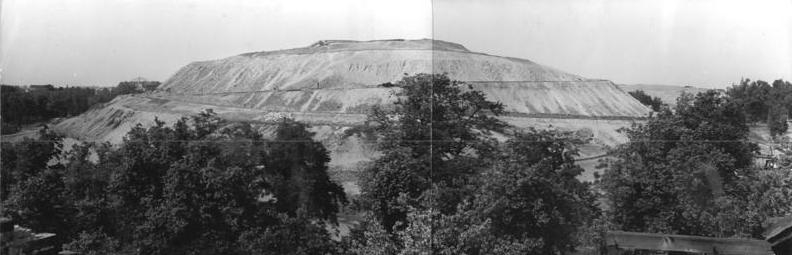
In Volkspark Friedrichshain – Berlin’s oldest public park, opened in 1848 – two green hills rise above the trees. They look entirely natural. They are not. The Großer Bunkerberg and the Kleiner Bunkerberg are artificial mountains built from war rubble on top of two demolished anti-aircraft bunkers.
Berliners gave the larger one an affectionate nickname: Mont Klamott, roughly “Mount Rubble.” It is one of the clearest examples anywhere of how post-war Berlin literally buried its recent past.
The flak towers and their destruction
During the Second World War, huge reinforced-concrete flak (anti-aircraft) bunkers were built in the park, part of Berlin’s air-defence system and also used as shelters. After 1945 the Allies ordered such fortifications demolished.
The bunkers were too massive to remove cleanly, so they were blasted and then covered. Over the following years the ruins were heaped with Trümmer – the rubble of a bombed city – and shaped into hills, then planted over.
A landscape made of a destroyed city
Berlin produced staggering quantities of rubble after the war. Rather than haul it all away, the city built several artificial hills, the Trümmerberge, across its parks and edges. Mont Klamott is the most storied of them.
Standing on top today, with families picnicking and dogs running, you are standing on the crushed remains of both the war machine and the bombed housing of 1940s Berlin. The 1950 photograph of the growing rubble mountain makes the transformation unforgettable.
Why it belongs on a hidden-history walk
Mont Klamott is the emotional centre of our tour precisely because it looks like nothing. Without context you walk past an ordinary park hill. With context, it becomes a compressed chapter of Berlin’s twentieth century: war, defeat, reconstruction and the green city that grew on top.
From here the tour connects backwards to the industrial Alter Schlachthof and forwards to the vanished Friesenstadion pool and the Ice Age valley that shaped the whole terrain.
Frequently asked questions
What does Mont Klamott mean?
It is a Berlin nickname for the Großer Bunkerberg, meaning roughly “Mount Rubble” – the hill is built from wartime debris.
Are there really bunkers under the hills?
Yes. Two demolished WWII flak bunkers lie beneath the Großer and Kleiner Bunkerberg, covered by rubble and soil.
Can you climb Mont Klamott?
Yes, paths lead up both hills in Volkspark Friedrichshain and they are freely accessible as part of the public park.
Under the Surface – A Hidden History Walk
Ask about a tourContinue reading
Alter Schlachthof Berlin: the hidden history of the central abattoir
The story of Berlin’s Alter Schlachthof (Zentralvieh- und Schlachthof) in Friedrichshain – from its 1881 opening to today’s neighbourhood, and how to read its industrial traces on a walking tour.
How the Ice Age shaped Berlin: the Urstromtal beneath the city
Why the Spree flows through the Berlin glacial valley, how meltwater and glaciers formed Prenzlauer Berg and Kreuzberg, and how to see the Ice Age in the modern city.